
Home / Access Control / Abu Dhabi
Abu Dhabi
Access Control Systems in Abu Dhabi
Nobody buys access control for its own sake. It usually starts with a specific problem. A tenant on Al Reem Island moves out and nobody knows how many fobs are still out there. A Musaffah workshop has a queue at the fingerprint machine every morning because half the team’s prints won’t read. Stock goes missing from a warehouse, and there’s no record of who was inside.
A well-designed access control system fixes all three the same way. Every door knows who’s allowed through and when, and it logs every attempt. A lost card or a leaver is switched off in seconds, from a screen.
AQLON designs, installs and maintains door access control in Abu Dhabi for offices, warehouses, factories, villas and multi-tenant buildings. Cabling, CCTV, intercom and gate barriers can sit on the same scope, so you deal with one team from survey to maintenance. The site survey costs nothing, and you get a fixed quote broken down door by door.
What an access control system includes
Whatever the brand, every access control system has five parts:
Credentials: what people present. A card or fob, a fingerprint, their face, a phone or a PIN.
Readers: the device beside the door that reads the credential.
Controllers: the unit, usually above the ceiling or in a comms room, that decides whether the door opens. A good one keeps working, and keeps logging, if the network or server goes down.
Locking hardware: magnetic locks, electric strikes or motorised locks, plus the exit button and emergency break-glass on the inside.
Software: where you add people, set schedules, run reports and cancel lost cards.
Most buyers spend their time comparing readers. In practice, the weak point is usually the door itself. A magnetic lock can’t hold a door that doesn’t close properly, and a weak closer won’t pull a door shut against air-conditioning pressure. That’s why the survey looks at how each door is built and how it’s used, not just where the reader goes. If you’re new to the subject, our plain-English guide to access control covers the basics.
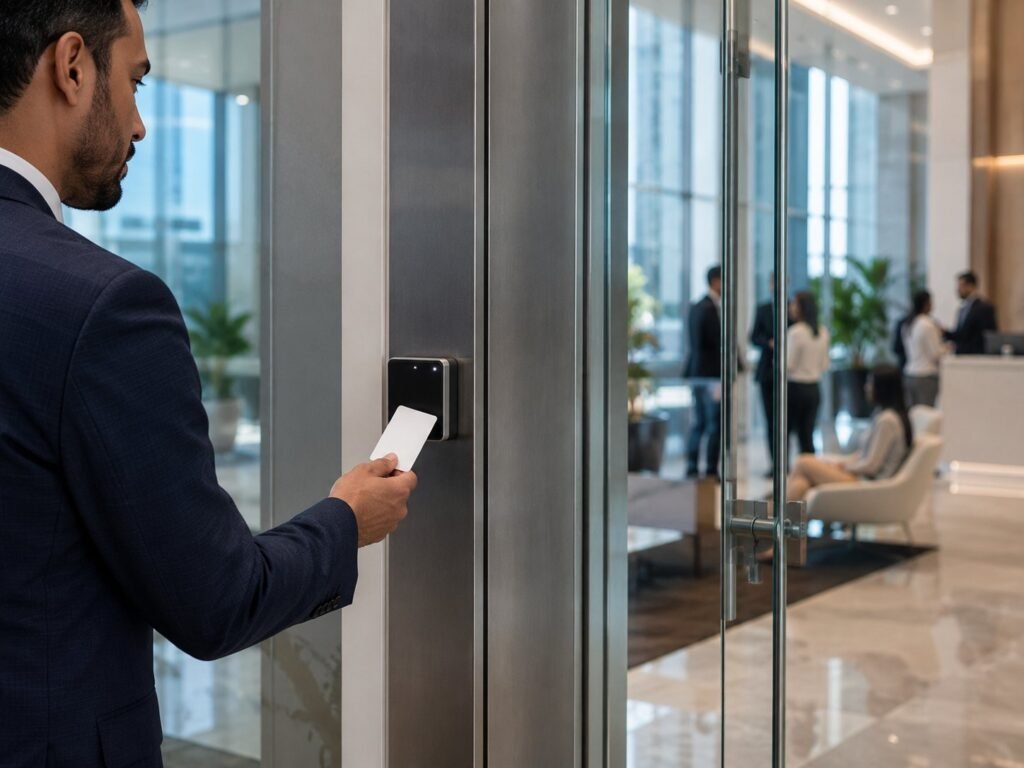
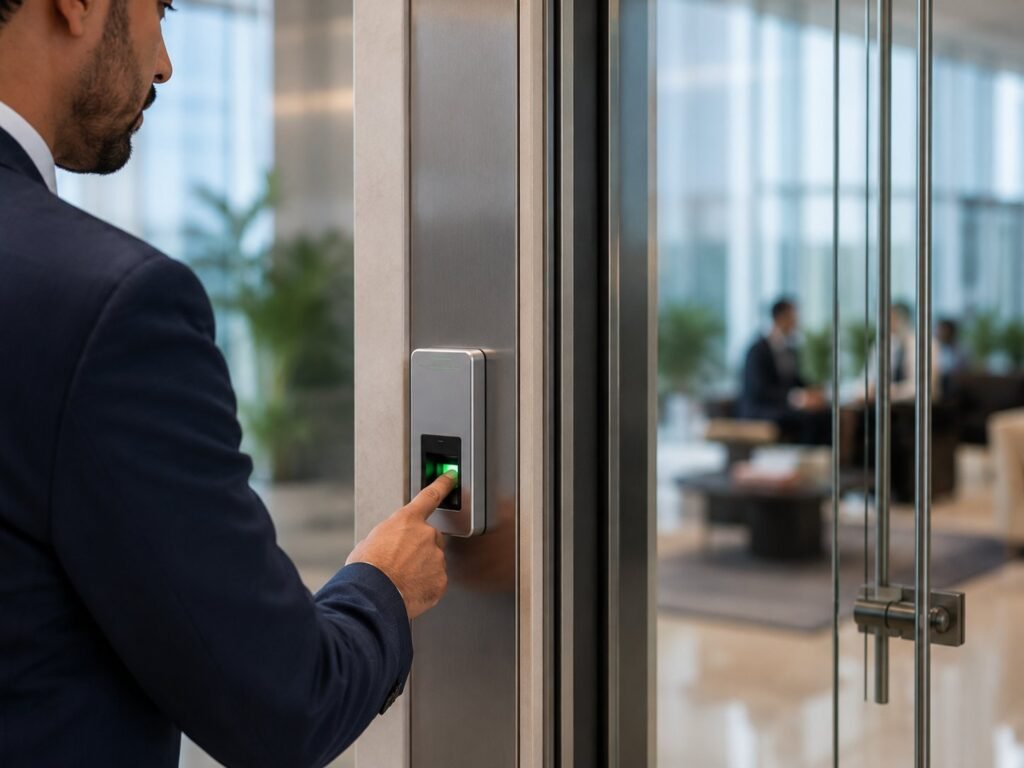
Card, fingerprint, face or phone: what works on Abu Dhabi sites
The right credential depends less on the technology and more on who walks through the door, how many of them, and what’s on their hands.
Offices and towers: Al Reem, Al Maryah and the city centre
For biometric access control in Abu Dhabi City offices, face recognition at the main office door is a popular choice. It’s touch-free, it’s quick, and nobody leaves their face at home. Mobile credentials suit managers who move between floors or branches. Keep cards for visitors and contractors, because they’re cheap to issue and easy to take back.
In multi-tenant towers, the same credential can also control the lifts, so a visitor’s pass only takes them to the floor they’re visiting. Where a lobby gets busy, a turnstile makes sure one card lets one person through, not two.
Warehouses, workshops and factories: Musaffah, ICAD and KEZAD
This is where fingerprint readers struggle. Hands that work with cement, oil, solvents or abrasives often have worn prints, and nobody wants to take gloves off at every door. A reader that rejects even a handful of people every morning isn’t a security system. It’s a queue.
Face recognition or cards usually work better here. It’s worth doing the queue maths as well. If 240 people clock in between 6:45 and 7:00 and each takes three seconds at the reader, one reader is busy non-stop for 12 minutes. Two readers, or a turnstile lane with a fast reader, halves that. We size the entry points from your real shift pattern, not a brochure.
Gates, yards and outdoor doors
Outdoor readers face sun, dust and the occasional forklift. Check three things on the datasheet:
- IP rating: IP65 or higher means the unit is dust-tight and protected against water jets.
- Operating temperature: compare it with where the reader will actually be mounted. A reader on a sun-facing gate in August runs far hotter than the shade temperature in the forecast.
- IK rating: impact resistance, for readers within reach of vehicles, trolleys or vandals.
A hood over a sun-facing reader costs little and helps it last. For vehicles, the same credentials can open gate barriers with ANPR.
Villas and compounds: Khalifa City, MBZ City, Yas and Saadiyat
At home, access control usually means the gate and the front door. A video intercom lets you see who’s there. A keypad or face reader works for family and staff, and a phone app lets in a delivery while you’re out. Give drivers and household staff their own credentials, so you can change their access without changing everyone else’s.
Server rooms and high-security rooms
Where one wrong entry matters, use two factors: card plus PIN, or card plus face. Add anti-passback, so a card can’t be used to enter twice without exiting, plus an alarm when a door is held open. Keep the logs.
Card security: is your card access system easy to copy?
If your card access system in Abu Dhabi went in more than a few years ago, there’s a fair chance it uses 125 kHz proximity cards or fobs. They work, but they have no real encryption. Devices that copy them are cheap and easy to buy online, and a copied card looks exactly like the real one to the system.
Encrypted smart cards close that gap. MIFARE DESFire EV2 or EV3 and HID Seos are common choices, and phone-based credentials work too. The wiring between reader and controller matters as well. The older Wiegand interface sends data unencrypted. OSDP with Secure Channel encrypts that link and reports if a reader is tampered with or disconnected.
For enterprise access control in the UAE, such as banks, data centres, government suppliers and head offices, write both into the specification: encrypted credentials and OSDP Secure Channel. You don’t have to switch everything overnight. Multi-technology readers can read old and new cards side by side while you reissue them.
Biometrics and UAE data protection law
Fingerprints and faces aren’t ordinary staff data. The UAE’s Personal Data Protection Law (Federal Decree-Law No. 45 of 2021) treats biometric data as sensitive personal data, and its definition names facial images and fingerprints. Before you enrol a whole workforce, it’s worth knowing a few points:
- Tell people what you collect and why. The law requires the purpose to be explained before processing starts (Article 13).
- Large volumes need an impact assessment. Article 21 requires one before processing a large volume of sensitive personal data.
- Delete what you no longer need. Data shouldn’t be kept once its purpose has been served (Article 5), so remove leavers’ fingerprint and face templates rather than just disabling the account.
- Know where a cloud platform keeps the data. Transfers outside the UAE have their own rules (Articles 22 and 23).
- Check which law applies to you. The PDPL doesn’t apply to government entities, or to free-zone companies covered by their own data protection law (Article 2). In Abu Dhabi that includes ADGM, which has its own Data Protection Regulations 2021.
There’s a simple design answer too: not every door needs biometrics. A card or phone on low-risk doors means there’s no biometric data to look after for those doors at all. At handover we show you where the data sits, who can see it and how it’s deleted, so your HR or legal team can sign it off.
This is a practical summary, not legal advice.
Is access control regulated in Abu Dhabi?
The MCC (ADMCC)
In Abu Dhabi, the Monitoring and Control Center (MCC, often called ADMCC) licenses companies working in monitoring and surveillance and publishes the national guides they work to. Its published regulations currently cover video surveillance: the National Guide for Video Surveillance Systems (third edition, dated 22 September 2026) and a companion guide on classifying the companies that work in that field. We haven’t found an MCC guide specific to door access control.
In practice, if your access control is integrated with cameras, the camera side follows MCC’s video surveillance requirements. Our page on ADMCC CCTV approval and registration explains that process. We confirm what applies to your premises during the survey.
Fire alarms and escape routes
Electric locks on escape routes have to work with the fire alarm, not against it. Escape doors are normally designed to release when the fire alarm activates and when power is lost, with a break-glass unit beside the door as a manual backup. Which doors, and exactly how, is set by the building’s fire strategy and its fire and life safety approvals. We coordinate the interface with your fire alarm contractor and test it at commissioning.
The flip side matters too. A stockroom door that springs open in every power cut isn’t secure. That’s why each door is set up as fail-safe or fail-secure on purpose, not by default.
Dubai works differently
Dubai has its own regulator for security systems, SIRA, and approvals don’t transfer between emirates. If you also have premises there, see access control in Dubai.
Access control and CCTV integration, attendance and gate barriers
The most valuable link is with your cameras. When the access system flags a forced door, a door held open, or a card used at 2 am, the camera clip should arrive with the alarm. Without the link, someone has to match timestamps by hand. If you’re planning both, design them together. We deliver CCTV installation in Abu Dhabi on the same scope, which is the simplest route to proper access control and CCTV integration in the UAE.
Other useful connections:
- Time and attendance: the same readers record clock-in and clock-out and export to your HR or payroll system, so you don’t need separate attendance machines.
- Gate barriers: staff and residents use one credential for the car park and the front door. We completed two automatic gate barriers in Abu Dhabi, including the civil works and foundations, and our gate barrier systems page covers the options.
- Intercom and visitors: visitors are pre-registered and get a pass that expires automatically. Reception sees who’s at the door before releasing it.
- Lifts: floor-by-floor control in towers and shared buildings.
All of this rides on the cabling underneath. Access control is part of the low-voltage package along with CCTV, intercom, data and gates. As an ELV company in Abu Dhabi, we run it on the same containment and the same drawings.
Multi-door and multi-site access control in Abu Dhabi
For a handful of doors, standalone readers can do the job. Beyond that you want a networked system: controllers handling two or four doors each, sitting in comms rooms on UPS power, all run from one piece of software. For multi-door access control in Abu Dhabi offices and industrial sites, a few design choices save trouble later:
- Offline operation. Controllers should hold the door database and keep logging if the server or network drops.
- Its own network segment. Agree a separate VLAN with your IT team, and keep it well away from guest Wi-Fi.
- One platform across branches. One enrolment, company-wide reports, and permissions set per site and per door. If you also have a Dubai branch, the same platform can run its doors and act as the biometric attendance system in Dubai too.
- Cloud or on-premise. Cloud platforms are easy to manage remotely but usually carry a yearly fee per door or reader. On-premise software is often a one-off licence plus maintenance. Compare them over five years, and ask how you’d export your data if you ever moved.
What affects the cost of access control in Abu Dhabi?
We don’t publish a price list, because two “ten-door systems” can be completely different jobs. These are the things that move the number:
- The doors. Glass office doors, fire-rated stair doors, roller shutters and gates all need different locks, and some need the door hardware fixed first.
- The credentials. Cards cost least per door, fingerprint more, face recognition more again. Mixing them by door is normal.
- The environment. Outdoor and industrial readers with higher IP and IK ratings cost more than office units, and they’re worth it where they’re needed.
- Distance and civil works. Long cable runs across a warehouse or yard, new containment and trenching to a gate all add labour.
- Software and licences. A one-off licence and a yearly cloud subscription look very different in year one and in year five.
- Integrations. CCTV, attendance export, lifts, visitor management and barriers each add scope.
Our survey costs nothing and our quotes are fixed, with every door priced separately. Whoever you choose, ask for any yearly software or cloud fees to be listed separately, so year two doesn’t bring a surprise.
Want a rough scope first? Send us your door list on WhatsApp.
Choosing an access control company in Abu Dhabi: eight questions to ask
Quotes for the same building can vary a lot, and the cheapest one often leaves something out. Before you sign, ask:
- Will you give me a door schedule showing the reader, lock, exit device and fail-safe or fail-secure setting for every door?
- What happens at each escape door when the fire alarm goes off, and when the power fails?
- Which card technology are you quoting, and can it be copied?
- Who holds the admin passwords and the system database after handover? (It should be you.)
- What are the yearly software, cloud or licence fees?
- Where is biometric data stored, who can see it, and how is it deleted?
- Who responds when a lock fails at 7 pm, and are spare parts held in the UAE?
- What does the maintenance contract cover: readers, locks, batteries, software updates?
A good installer answers all eight without hesitating. Our guide to choosing an ELV contractor in Abu Dhabi goes further.
Access control installation in Abu Dhabi: how a project runs
- Free site survey. We walk every door you want controlled, check how it’s built and how it’s used, mark the escape routes, and plan cable paths back to a comms room.
- Design and fixed quote. You get a door schedule, a credential plan and the integration scope, followed by an itemised quotation.
- Installation and commissioning. Work is phased so no door is left unsecured overnight. Every door is tested, including the fire alarm release with your fire contractor, and your users are enrolled.
- Handover and support. Your team is trained to add and remove users and run reports. You receive the as-built drawings and the admin logins for the system software, whichever platform you’ve chosen. We also offer maintenance contracts covering readers, locks, batteries and software.
Areas we cover in Abu Dhabi
We work across Abu Dhabi City, Al Reem Island, Al Maryah Island, Musaffah, ICAD, KEZAD, Khalifa City, Mohammed Bin Zayed City, Al Raha, Yas Island, Saadiyat Island and Al Ain, from our base in Musaffah M-9. For the wider picture, see access control systems across the UAE.
Frequently asked questions
How much does an access control system cost in Abu Dhabi?
It depends on the number and type of doors, the credentials, the environment, cabling distances, software licensing and integrations. That’s why we quote after a free survey. You get a fixed quotation, itemised door by door. A single office door and a multi-site biometric system are completely different budgets.
Does access control need MCC (ADMCC) approval in Abu Dhabi?
The MCC’s published guides cover video surveillance systems, and we haven’t found one specific to door access control. If your access control is integrated with CCTV, the camera side follows MCC requirements. We confirm what applies to your premises during the survey.
Is fingerprint or face attendance allowed under UAE data protection law?
It can be, with care. Biometric data is classed as sensitive personal data under the PDPL. Tell staff what you collect and why, protect the data, delete it when it’s no longer needed, and carry out an impact assessment if you process a large volume. Companies in ADGM follow ADGM’s own data protection rules. Check the details with your legal adviser.
Which is better for a warehouse: card, fingerprint or face?
Usually face or card. Fingerprint readers struggle with worn or dirty fingers and gloved hands, which are common in warehouses and workshops. Size the number of readers to your busiest shift change, so nobody queues at the gate.
What happens to the doors in a power cut or fire alarm?
Each door is set up as fail-safe (it unlocks when power is lost) or fail-secure (it stays locked), depending on its role. Escape-route doors are designed to release on fire alarm, with a manual break-glass as backup. Controllers and locks run on battery backup, so security doesn’t disappear in a short outage.
Can access control be integrated with our existing CCTV?
Often, yes. It depends on the two platforms. Some connect directly, while others need an integration licence or a simple alarm-output link. We check what you have during the survey and tell you what’s possible before you commit.
Can you upgrade our old system without replacing everything?
Usually in part. Sound cabling, locks and door hardware can often be reused. Multi-technology readers can read your old cards and new encrypted ones side by side, so you can reissue cards in stages. Controllers and software are the parts most often replaced.
Which access control brand is best?
There’s no single best brand. The better question is which system has local support and spares in the UAE, encrypted credentials, sensible licence costs, and the integrations you need. We’ll explain the options and the trade-offs in plain terms.
How long does installation take?
It depends on the doors and the building. Most of the time goes on door hardware and cabling, not the readers. On fit-outs we work to the main contractor’s programme, and we put a realistic schedule in writing with the quote.
Get a free access control survey in Abu Dhabi
Send us a floor plan or a simple list of the doors you want controlled. WhatsApp is fine. We’ll come back with a few questions, then visit the site. You get a door schedule and a fixed, itemised quote, with one team responsible for access control, CCTV, cabling and maintenance.
Last reviewed: October 2026